5th Grader Quiz: Are You Smart
- 4.5
- Rating
- 100.00K
- Installs
- Free
- Price
 Analysis by App-foxy
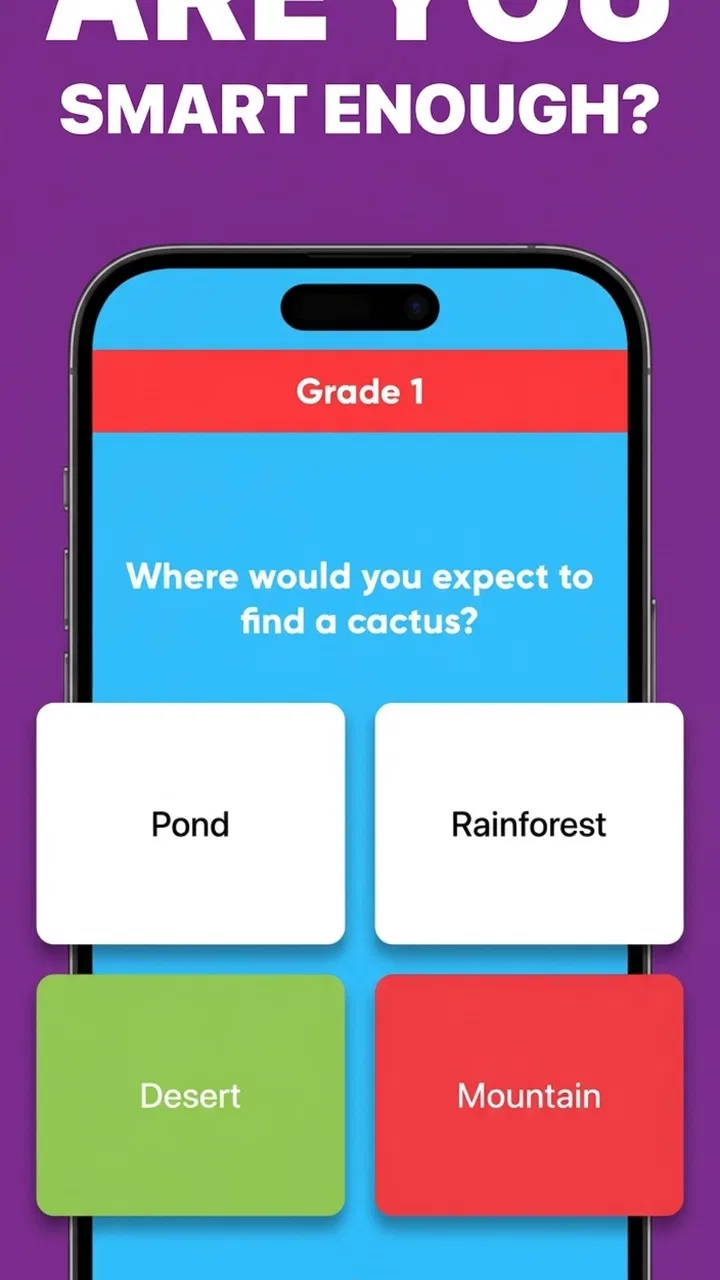
I like trivia games that make me think without demanding a long commitment, and 5th Grader Quiz: Are You Smart fits that narrow space well. It is a free general-knowledge game from KDR Games, built around a simple challenge: can I handle questions aimed at the level of a fifth grader? That premise sounds easy until a familiar subject is presented in a slightly different way. The result is a light quiz that works especially well for short breaks, casual competition, or a quick test of what I still remember from school.
The important thing is not to approach it as a serious learning platform. I see it more as a compact trivia game with an educational flavor. It gives me a reason to recall facts, notice gaps, and compare my confidence with my actual answer. The game is free to install, suitable for Everyone, and available on devices running Android 6.0 or later. Its current version is 11.0.2, so it is aimed at a broad range of Android users rather than only people with new phones.
Why the fifth-grade challenge works
The strongest capability here is the way the game turns ordinary school knowledge into a personal challenge. Instead of asking me to specialize in one subject, it moves through general knowledge and tests whether I can switch mental gears. One question may feel obvious, while the next exposes a forgotten detail. That contrast keeps the experience more engaging than simply answering a sequence of facts from one narrow topic.
You May Also Like

 Blood Strike: 2.5 Anniversary
Blood Strike’s Loadouts Turn Every Drop Into a Tactical Gamble
A close look at Blood Strike’s custom loadouts: how fast access to signature weapons reshapes its battle royale rhythm, rewards preparation, and narrows the gap between fights.

 Pandora - Music & Podcasts
Pandora’s Music Is Easy to Start, but Harder to Recover
Pandora’s strength is its low-effort path from a seed to a station. Its weak spot is how much confidence it asks you to place in connection, setup, and quiet recovery.

 8 Ball Pool
 Is Built on Rivalries, Rematches, and Routine
A close look at the rivalries, rematches, shared routines, and unanswered safety questions that turn a quick pool match into a persistent mobile community.

 Samsung Music
’s Quiet Strength Is Playing What You Already Own
Its reach comes less from spectacle than from dependable access to a personal library. That simplicity is both the app’s strongest retention engine and its ceiling.

 AccuWeather: Weather Radar
AccuWeather Review: A Quick, Clear Forecast for Everyday Decisions
For everyday plans, the best forecast is the one you can understand quickly. AccuWeather makes rain timing, radar, and local conditions easy to act on, with a few trade-offs.

 Hill Climb Racing
Why Hill Climb Racing Still Turns Crashes Into One More Run
A tiny car, a bumpy hill and one more upgrade: Hill Climb Racing keeps resurfacing because its simple chaos makes every near-miss feel personal.
More From Our News Desk



Calling the quiz “fifth grade” also changes how I play. I do not expect obscure expert questions, so I begin with confidence. Then I discover that basic questions can be surprisingly demanding when I am answering quickly. This makes the game useful for checking genuine recall rather than relying on the feeling that I have seen a subject before.
The real appeal is the gap between “I know this” and proving it under quiz pressure. That gap gives the game its personality. It is approachable for children and adults, but adults may find the challenge particularly amusing because the questions can highlight information they once learned and later stopped using.
In my experience, this makes the game a better fit for relaxed mental exercise than for formal study. It encourages attention and memory, but I would not use it as a replacement for a textbook, a classroom, or a structured revision app. The questions can prompt curiosity, yet the main reward comes from the act of answering, not from building a complete course of knowledge.
A simple format with a useful social side
The uncomplicated setup is one of its strengths. I can open the game when I have only a few minutes and start testing myself without preparing a topic or setting aside a full session. That makes it suitable for a commute, a waiting room, or a short pause between tasks. It also gives the game a natural social use: two people can take turns answering and see who is more reliable on supposedly easy questions.
That social use works best when players avoid turning every mistake into an argument. General-knowledge questions often depend on careful reading, and a confident answer is not always a correct one. I found that the game is more enjoyable when the point is to compare reasoning and learn which subjects each person remembers well, rather than treating every round as a formal contest.
The rating of 4.4 from around 1.3 thousand ratings suggests that many players find this balance appealing. I would not treat that number as a guarantee that every question will suit every player, but it does match my impression of the game as an accessible, familiar-style quiz rather than an intimidating test.
How I use it in practice
When I play, I try not to rush through the first answer that comes to mind. The most useful habit is to read the entire question, identify exactly what it asks, and only then choose. This matters because a fifth-grade-level question can still contain a distinction that changes the answer. Slowing down by a moment improves the experience and turns mistakes into something I can examine instead of simply dismissing as bad luck.
A second useful approach is to treat uncertain answers as information about my memory. If I am torn between two choices, I note what made each one seem plausible. That small pause reveals whether I am recalling a fact, confusing it with another fact, or guessing from the wording. For me, this is where the quiz has more value than a purely reflex-based game.
I also prefer playing in short sessions. A few rounds keep the questions feeling fresh and prevent the experience from becoming repetitive. If I continue for too long, the basic format can lose some of its impact, especially when I am no longer focused. The game is at its best as a repeatable pocket activity, not as something I would play continuously for an evening.
What a mistake can teach you
One non-obvious benefit is that wrong answers can expose overconfidence more clearly than difficult questions do. When I miss something I considered obvious, I am more likely to remember the correction because it challenges my assumption. I recommend mentally grouping mistakes afterward: facts I genuinely forgot, questions I misread, and answers I guessed. Each group points to a different improvement.
Forgotten facts may be worth looking up separately if they matter to you. Misread questions suggest that you should slow down. Guesses show where the quiz is testing recognition rather than firm knowledge. This simple review habit gives the game a more useful role without pretending that it provides a full explanation for every subject.
Another practical tip is to play with someone whose strengths differ from yours. A friend who remembers science may struggle with history, while another person may be better with language or everyday facts. That makes the game a conversation starter and helps prevent one player from assuming that a single score represents overall intelligence.
The best everyday scenario
The clearest use case is a short break shared with another person. Imagine waiting for food at a café or sitting with family after dinner. One person opens the quiz, answers a question, and passes the phone over. The session can stay informal: discuss an uncertain answer, laugh at an unexpected mistake, and stop whenever the conversation moves on. The game does not need a special setup, which is exactly why it works in that situation.
I also think it suits parents or older siblings who want a low-pressure activity with a child. Because the content rating is Everyone and the concept is based on familiar school knowledge, the subject matter is easier to approach than a specialized adult trivia game. Still, I would play alongside a younger child rather than simply handing over the phone and expecting the game to teach independently. Conversation is what turns a correct or incorrect answer into a useful moment.
For solo play, it works well during small gaps in the day. I would choose it when I want something more active than scrolling but less demanding than reading a long article. The questions create a clear mental task, and the short format lets me leave without losing an entire block of time.
It is less suitable when I need detailed explanations, progress tracking for a school subject, or carefully organized revision. In those situations, a dedicated learning app or a subject-specific quiz would be a better choice. This game’s strength is breadth and accessibility, not depth.
Where the trade-offs appear
The same simplicity that makes the game easy to start also limits how deeply I can engage with it. A general-knowledge quiz can tell me whether my answer was right or wrong, but that alone may not explain why. If I want context, examples, or a lesson built around a mistake, I have to continue the learning elsewhere. That is not a flaw in a casual trivia game, but it is an important boundary.
There is also a difference between being challenging and being educational. A question can make me think without helping me retain the answer afterward. I get more value when I write down a surprising fact or look it up after playing. Without that extra step, the experience remains mostly a test of recall.
The game’s broad audience can create another trade-off. A question that feels too easy for one player may be genuinely difficult for another, while an adult may remember the subject but not the exact school-level detail. That variability is part of the fun, but players looking for consistently difficult competition may outgrow it. A specialist trivia app would be better for advanced enthusiasts who want narrow categories or a more demanding knowledge test.
Free access makes it easy to try, although in-app purchases are listed at $0.99 per item. I would keep that in mind if a child is using the device or if you prefer a completely purchase-free experience. The game itself is free, but the presence of optional paid items means I would check the device’s purchase controls before sharing it with a younger player.
The audience size also gives useful context. With over 100 thousand installs and around 100 reviews, it is clearly not an obscure experiment, but it is still a focused casual title rather than a massive trivia community. I would not choose it expecting a large competitive ecosystem or a constantly changing social scene. I would choose it for the direct quiz experience.
How it compares with familiar alternatives
Compared with a crossword, this game asks for quicker recall and less patience with clues. Compared with a flashcard app, it feels more playful but gives me less control over what I study. Compared with a multiplayer trivia title, it is better for a quiet solo break or a face-to-face exchange that does not depend on coordinating with online players. Each alternative has a clearer specialty, while this one occupies the middle ground of broad, approachable questioning.
That middle ground is useful if I do not want to choose a subject in advance. I can open it with no plan and let the quiz decide what kind of memory I need. The compromise is that I cannot shape the experience as precisely as I could with a history, language, mathematics, or science app. I would pick this game for variety, and a focused alternative when my goal is improvement in one area.
Who will get the most from it
I recommend it most to people who enjoy quick knowledge checks, families looking for a simple shared activity, and casual players who like discovering that “easy” questions are not always easy in practice. It can also suit adults who want a light memory workout without the pressure of a formal brain-training program.
Students may enjoy it as a break from studying, but I would not count on it for curriculum-aligned revision. Its broad approach makes it entertaining, yet it may not cover the exact topics or order needed for an exam. Teachers or parents could use individual questions as conversation prompts, but the game should support learning rather than stand in for it.
I would skip it if you want deep explanations, advanced difficulty, specialized categories, or a strong competitive ranking system. I would also skip it if you dislike quizzes that revisit basic knowledge or if you prefer games with rich visuals, stories, or complex progression. The appeal here is deliberately modest: open the app, think, answer, and see how well your everyday knowledge holds up.
For Android users, the technical entry point is fairly broad because it supports Android 6.0 and later. KDR Games has kept the concept focused, and the current version, 11.0.2, makes it straightforward to identify what to install. The Everyone rating also makes it easier to consider for shared household use, while adults should still supervise purchases when children have access to the device.
After spending time with it, my view is positive but specific. I would recommend it as a free trivia game for short, low-pressure sessions, especially when I want to challenge my memory without committing to a full lesson or a complicated multiplayer match. Its greatest strength is the way a familiar school-level premise exposes overconfidence and encourages careful reading. Its biggest weakness is that the quiz format alone cannot provide the depth or explanations that serious learners may want.
5th Grader Quiz: Are You Smart is therefore best understood as a conversation-friendly knowledge check, not a complete educational tool. If that is what you want, the simple format is an advantage: it starts quickly, works for solo or shared play, and gives ordinary facts enough tension to become entertaining. I would keep it installed for those spare moments when I want to put my memory on the spot and leave with either a small victory or a fact worth investigating.
FAQs for 5th Grader Quiz: Are You Smart
01What is the main objective of 5th Grader Quiz: Are You Smart?
The primary goal of 5th Grader Quiz: Are You Smart is to test your knowledge based on questions typically found in a fifth-grade curriculum. It challenges users to see if they can recall information from subjects like math, science, history, and more. It’s both entertaining and educational, making it ideal for all ages.
02Is 5th Grader Quiz: Are You Smart suitable for children?
Yes, the app is suitable for children, especially those in elementary school. It provides a fun way for kids to engage with educational content and reinforces what they learn in school. However, the app can also be challenging for adults looking to test their memory and knowledge.
03Does 5th Grader Quiz: Are You Smart require an internet connection?
An internet connection is required to download the app and access certain features, like leaderboard updates and additional question packs. However, once downloaded, many of the core quizzes can be played offline, making it convenient for users on the go or without consistent internet access.
04Are there in-app purchases or ads in 5th Grader Quiz: Are You Smart?
The app features both in-app purchases and ads. Users can buy additional question packs or remove ads through these purchases. While ads may appear between quizzes, they are typically non-intrusive and can be removed if you choose to upgrade to a premium version.
05How does 5th Grader Quiz: Are You Smart compare to similar quiz apps?
5th Grader Quiz: Are You Smart stands out with its focus on educational content tailored to a fifth-grade level. Unlike some quiz apps that focus solely on entertainment, this app balances learning with fun. It’s ideal for users who enjoy educational challenges and want to refresh their knowledge in various subjects.
Pros
- Engaging questions enhance learning
- User-friendly interface for all ages
- Educational content suited for kids
- Entertaining graphics and sounds
- Offline mode available for convenience
Cons
- Limited question variety over time
- Ads can interrupt gameplay
- No multiplayer mode available
- Requires frequent updates
- Some questions are region-specific

5th Grader Quiz: Are You Smart
Gallery